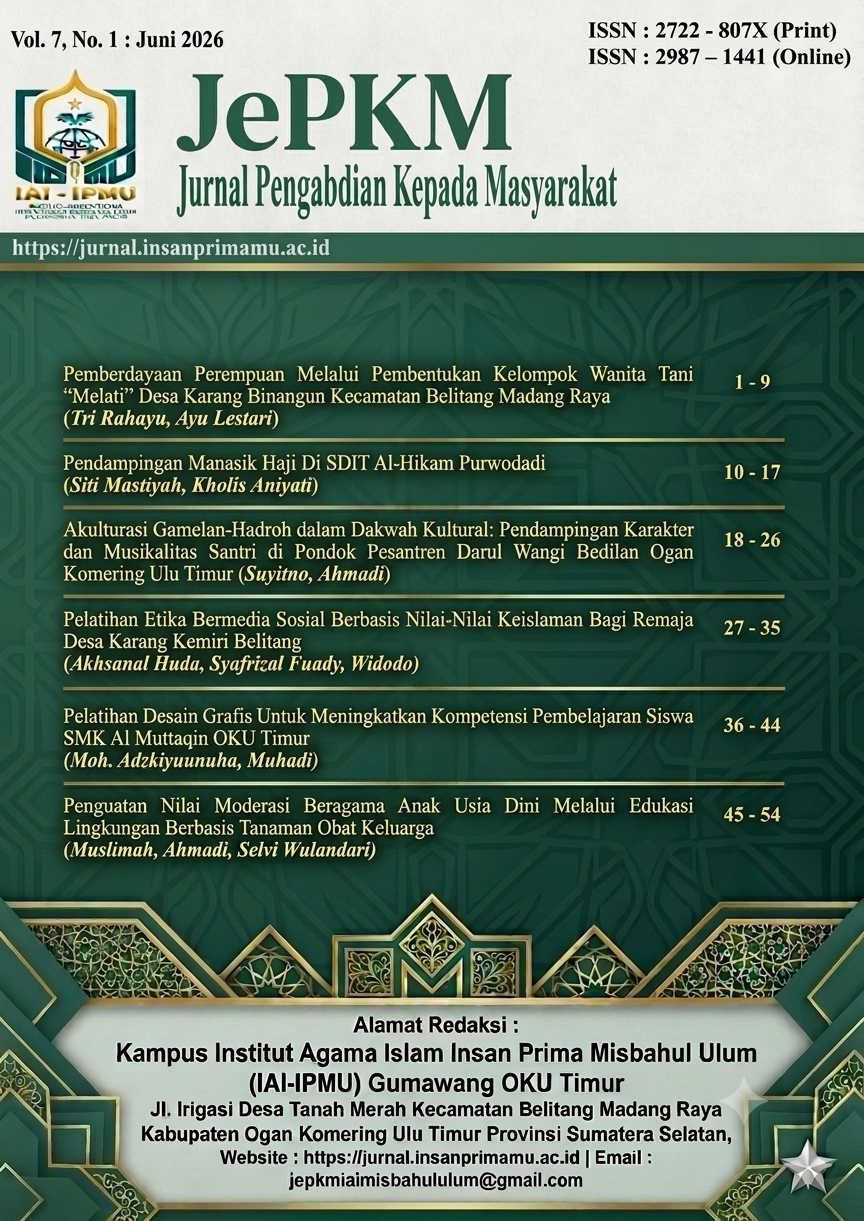
Gamelan-Hadroh Acculturation in Cultural Dawah: Mentoring Santri’s Character and Musicality at Darul Wangi Islamic Boarding School, Bedilan, East Ogan Komering Ulu
DOI:
https://doi.org/10.70688/jepkm.v7i1.608Keywords:
Cultural Dawah, Gamelan-Hadroh, Isolated Group Practicing, Musical Acculturation, Student CharacterAbstract
The utilization of traditional musical instruments in Islamic boarding schools (pesantren) often faces challenges such as limited instructors, stagnation in innovation, and poor rhythmic tempo stability in students' musical performance. This community service program aims to optimize the function of gamelan instruments through a clinical mentoring method acculturated with Islamic percussion instruments (hadroh) as a medium for cultural dawah. The partner for this program is the Darul Wangi Islamic Boarding School, Bedilan, East Ogan Komering Ulu. The implementation method was based on a participatory approach that included physical observation, collaborative arrangement formulation, and focused training using the isolated group practicing technique to separate the focus of male and female students based on group gender comfort. The psychomotor evaluation results showed a 100% success rate, with the students successfully mastering four collaborative sholawat arrangements with smooth tempo transitions. Affectively, this program successfully internalized core character values of discipline, reduction of sectoral ego in teamwork, and boosted students' self-confidence through an evaluation staging performance. Furthermore, this cross-cultural integration provides a tactical contribution to strengthening religious moderation and providing an emotional catharsis space for students. The program sustainability strategy has also been institutionalized through the establishment of an independent musical group management to ensure the continuity of inclusive cultural dawah in the modern era.
References
Ahmadi, A. (2019). Konsep Pendidikan Karakter Dalam Hadits. Al-Misbah (Jurnal Prodi PGMI), 5(2), 1–14. https://doi.org/https://doi.org/10.70688/almisbah.v5i02%20Desember.67
Ahmadi, A. (2020). Konsep Pendidikan Akhlak Tasawuf Menurut Nurcholish Madjid Dan Relevansinya Dengan Pendidikan Islam. Al-Misbah (Jurnal Prodi PGMI), 6(1), 21–35.
Ahmadi, A. (2024). Manajemen Pendidikan Islam Dan Tantangan Modernisasi: Tinjauan Literatur. Misbahul Ulum (Jurnal Institusi), 6(2), 145–165.
Ahmadi, A. (2025). Transformasi Pembelajaran Pendidikan Islam Berbasis Moderasi Beragama dalam Penguatan Karakter Peserta Didik. Tarbiyatul Misbah (Jurnal Kajian Ilmu Pendidikan), 18(2), 92–105. https://doi.org/https://doi.org/10.70688/tarbiyatulmisbah.v18i2.557
Akhsanul, H., Ahmadi, A., & Ahmad, J. (2024). Pelatihan dan Pendampingan Musik Hadroh Al–Habsyi pada Grup Hadroh Khusus Jamaah Ibu–Ibu Di Desa Karang Jaya Kecamatan Belitang II Kabupaten OKU Timur. JePKM (Jurnal Pengabdian Kepada Masyarakat), 5(1), 1–8.
Jannah, R., Jamaludin, M., & ... (2024). Pelestarian Budaya Lokal Melalui Pengembangan Modul Aksara Jawa untuk Masyarakat Pesantren. Jurnal Pendidikan …, 9(1). https://journal.uin-suka.ac.id/tarbiyah/JPM/article/download/9922/3734
Mahrovi, M., Ahmadi, A., & Wasiati, W. (2023). Pelatihan Seni Kaligrafi Dalam Meningkatkan Kreativitas Santri MDTA Raden Fatah Di Desa Suka Negara. JePKM (Jurnal Pengabdian Kepada Masyarakat), 4(1), 32–41. https://doi.org/https://doi.org/10.70688/jepkm.v4i01.306
Murcahyanto, H., Murni, R., & Murcahyaningrum, S. (2023). Pengembangan diri pensiunan perantau Jawa melalui pelatihan seni gamelan di Lombok Timur. ABSYARA: Jurnal Pengabdian pada Masyarakat, 4 (2) …. 4(2), 187–197. https://doi.org/https://doi.org/10.29408/ab.v4i2.24130
Sudarwati, S., Andari, N., & Dewi, N. (2023). Pemertahanan Budaya Lokal melalui Pemberdayaan Kelompok Seni di Desa Jenisgelaran Jombang. PROSIDING SEMINAR NASIONAL PENGABDIAN …. 3(1), 1–17. https://doi.org/https://doi.org/10.33086/snpm.v3i1.1226
Downloads
Published
How to Cite
License
Copyright (c) 2026 Suyitno, Ahmadi

This work is licensed under a Creative Commons Attribution-ShareAlike 4.0 International License.
This article is licensed under the Creative Commons Attribution 4.0 International License (CC BY 4.0). The author(s) retain copyright and grant the journal the right to publish this work.