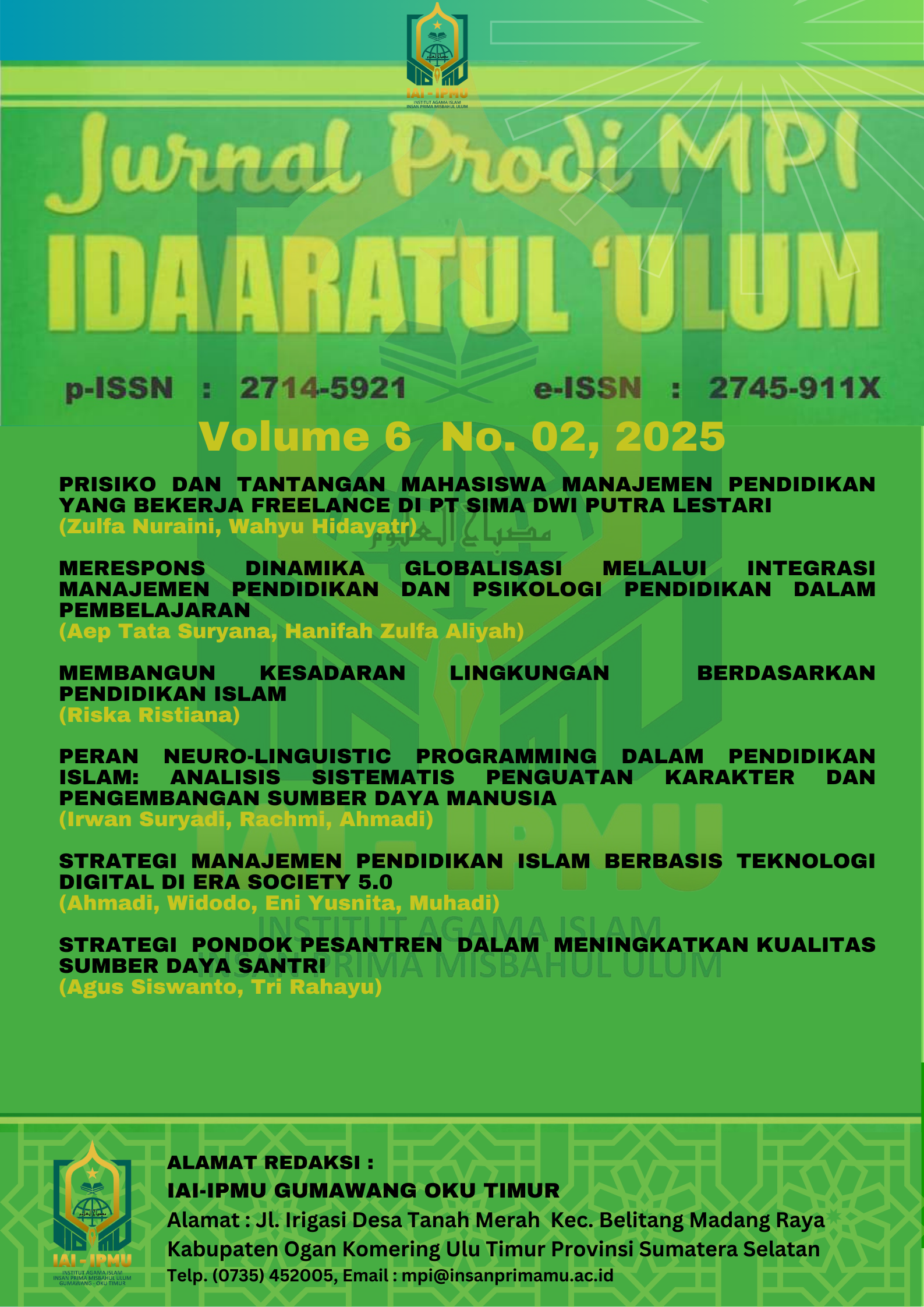
Peran Neuro-Linguistic Programming dalam Pendidikan Islam: Analisis Sistematis Penguatan Karakter dan Pengembangan Sumber Daya Manusia
DOI:
https://doi.org/10.70688/idaarotululum.v7i2.579Keywords:
Neuro-Linguistic Programming,, Islamic Education, Character Building,, Human Resource DevelopmentAbstract
Islamic education plays a strategic role in shaping students’ character and developing human resources who are faithful, ethical, and competent. A major challenge is strengthening educators’ character and professionalism amid social dynamics and the complexities of modern human needs. This study examines the role of Neuro-Linguistic Programming (NLP) in Islamic education as a strategic approach for character building and human resource development. A qualitative approach using Library Research within a Systematic Literature Review (SLR) framework was employed, analyzing 34 relevant journals, books, and scientific proceedings. The findings show that NLP enhances self-awareness, emotional regulation, motivation, and effective communication, reinforcing positive character and behavior among students. Moreover, NLP supports educators’ professionalism and promotes value-based leadership and human resource management in Islamic educational institutions. Integrating NLP with ethical and prophetic leadership principles can sustainably improve human resource quality. The study concludes that NLP serves as a complementary, adaptive, and humanistic approach aligned with Islamic education goals, offering theoretical, practical, and policy implications for managing Islamic educational institutions.
References
Abdullah, M. A. (2017). Islamic studies in higher education in Indonesia: Challenges, impact and prospects for the world community. Al-Jami’ah: Journal of Islamic Studies, 55(2), 391–426. https://doi.org/10.14421/ajis.2017.552.391-426
Adnan, M. (2022). Islamic education and character building in the industrial revolution 4.0. Nazhruna: Jurnal Pendidikan Islam, 5(1), 11–21. https://doi.org/10.31538/nzh.v5i1.1771
Ahmadi, A. (2019). Konsep Pembinaan Pendidikan Karakter. Tarbiyatul Misbah (Jurnal Kajian Ilmu Pendidikan), 12(02), 89–114. https://doi.org/10.70688/tarbiyatulmisbah.v12i02
Alimron, A., Syarnubi, S., & Maryamah, M. (2023). Character education model in Islamic higher education. Al-Ishlah: Jurnal Pendidikan, 15(3), 3334–3345. https://doi.org/10.35445/alishlah.v15i3.1452
Anjomshoa, M. R., Devin, H. F., Esmailzadeh, M. R., & Keshtidar, M. (2020). Effects of neuro-linguistic programming course on job stress, positive organizational behavior and job motivation. Pedagogy of Physical Culture and Sports, 24(3), 111–117. https://doi.org/10.15561/26649837.2020.0302
Buckley, P., & Irawan, I. (2015). The scientific paradigm of Islamic education management: Phenomenology perspective. Jurnal Pendidikan Islam, 2(1), 1–29. https://doi.org/10.15575/jpi.v2i1.701
Caldwell, C. (2017). Understanding kindness: A moral duty of human resource leaders. Journal of Values-Based Leadership, 10(2), 1–15.
Demirtas, O. (2015). Ethical leadership influence at organizations: Evidence from the field. Journal of Business Ethics, 126(2), 273–284. https://doi.org/10.1007/s10551-013-1950-5
Drigas, A., Mitsea, E., & Skianis, C. (2021). Neuro-linguistic programming, positive psychology & VR in special education. Scientific Electronic Archives, 15(1), 1–10. https://doi.org/10.36560/15120221497
Espinales, A. N. V, & Moreno, J. A. V. (2021). Neuro-linguistic programming in the teaching-learning process of English as a foreign language. PalArch’s Journal of Archaeology of Egypt/Egyptology, 18(4), 5566–5579.
Fehr, R., Yam, K. C., & Dang, C. (2015). Moralized leadership: The construction and consequences of ethical leader perceptions. Academy of Management Review, 40(2), 182–209. https://doi.org/10.5465/amr.2013.0358
Furduescu, B. A. (2019). Neuro-linguistic programming: History, conception, fundamentals and objectives. Valahian Journal of Economic Studies, 10(1), 39–46. https://doi.org/10.2478/vjes-2019-0004
Gu, Q., Tang, T. L. P., & Jiang, W. (2015). Does moral leadership enhance employee creativity? Journal of Business Ethics, 126(3), 513–529. https://doi.org/10.1007/s10551-013-1967-9
Hikmawati, A., Makruf, I., & others. (2024). Integrating the principles of Prophet Ibrahim’s exemplary leadership in human resource management within Islamic educational institutions. Al-Ishlah: Jurnal Pendidikan, 16(1), 123–138.
Ilham, D. (2020). The challenge of Islamic education and how to change. International Journal of Asian Education, 1(2), 1–12.
Ilyas, M. (2017). Finding relationships between acquisition of basic skills and neuro-linguistic programming techniques. Constructions, 8(1), 45–56.
Javadi, Y., & Asl, S. A. (2020). Neuro-linguistic programming, teacher’s identity, and teachers’ effectiveness. Journal of Language Teaching and Research, 11(3), 389–398. https://doi.org/10.17507/jltr.1103.07
Keezhatta, M. S. (2019). The impact of neuro-linguistic programming on English language teaching. International Journal of English Linguistics, 9(6), 454–466. https://doi.org/10.5539/ijel.v9n6p454
Khaidir, E., & Suud, F. M. (2020). Islamic education in forming students’ characters. International Journal of Islamic Educational Psychology, 1(1), 50–63. https://doi.org/10.18196/ijiep.1105
Komariah, N., & Nihayah, I. (2023). Improving the personality character of students through Islamic religious education learning. At-Tadzkir: Islamic Education Journal, 2(1), 15–28.
Okolie, U. C., Omole, O. G., & Yakubu, A. (2021). Leadership and Effective Human Resource Management in Organization. RUDN Journal of Public Administration, 8(3), 277–296. https://doi.org/10.22363/2312-8313-2021-8-3-277-296
Popescu, C. D. (2023). The path to outstanding education based on neuro-linguistic programming. Dialogue in a Global World, 10, 211–220.
Pratama, A., & Qorib, M. (2024). Analysis of Islamic education program at Taqwa Mosque Durian Village Medan. Edukasi: Jurnal Pendidikan Islam, 12(1), 45–58.
Rahaman, A., & Pattnaik, D. P. P. (2024). Integrating neuro-linguistic programming and multiple intelligences in language learning. Educational Administration: Theory and Practice, 30(1), 1–15.
Rogozińska, E. (2016). Neuro-linguistic programming for teaching and learning. Journal of Linguistic and Intercultural Education, 9, 33–45.
Sahin, A. (2018). Critical issues in Islamic education studies. Religions, 9(11), 335. https://doi.org/10.3390/rel9110335
Seitova, S. M., Kozhasheva, G. O., Gavrilova, Y. N., Tasbolatova, R., Okpebaeva, G. S., & Kydyrbaeva, G. T. (2016). Peculiarities of using neuro-linguistic programming techniques in teaching. International Electronic Journal of Mathematics Education, 11(5), 1135–1149.
Sharif, S., & Aziz, E. A. (2015). Application of neuro-linguistic programming techniques to enhance the motivation of at-risk students. International E-Journal of Advances in Education, 1(3), 168–176.
Supriyanto, S., Amrin, A., & Rifa’i, A. A. (2022). Islamic education paradigm on religious understanding in Indonesia. Akademika: Jurnal Pemikiran Islam, 27(2), 189–206.
Suyadi, S., & Sutrisno, S. (2018). A genealogical study of Islamic education science. Al-Jami’ah: Journal of Islamic Studies, 56(1), 29–58. https://doi.org/10.14421/ajis.2018.56102
Tolchah, M., & Mu’ammar, M. A. (2019). Islamic education in the globalization era. Humanities & Social Sciences Reviews, 7(4), 1031–1037.
Tyas, E. H., Sunarto, S., & Naibaho, L. (2020). Building superior human resources through character education. TEST Engineering & Management, 83, 11864–11873.
Widyatmoko, W. F., Pabbajah, M., & Widyanti, R. N. (2020). The character of leadership in human resources development: A critical review. International Journal of Innovation, Creativity and Change, 13(3), 1–15.
Zaman, M. (2018). Islamic education: Philosophy. In Handbook of Islamic Education (pp. 1–15). Springer. https://doi.org/10.1007/978-3-319-64683-1_2
Downloads
Published
How to Cite
License
Copyright (c) 2025 Idaarotul Ulum (Jurnal Prodi MPI)

This work is licensed under a Creative Commons Attribution-ShareAlike 4.0 International License.